












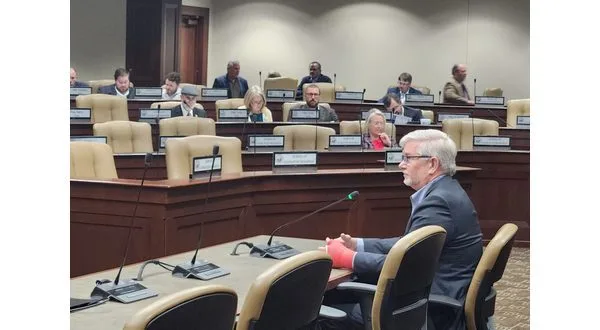
A member of the Arkansas Board of Corrections challenged legislators about the need for a new 3,000-bed prison and offered less expensive alternatives on Monday.
The corrections board “is acutely aware” of the need for a new facility, Lee Watson wrote in an email, but has never asked for a 3,000-bed prison, and has never been told that such a large facility is necessary nor been provided with any evidence that it is needed.
“Our needs don’t support a 3,000-bed facility when the county jail backup is 1,600,” Watson said.
County jails house inmates for whom there is no room in state facilities, and county sheriffs have complained to lawmakers for years about the need for a solution. The state prison population as of March was 16,706, according to a Division of Correction report. The county jail backup total was 1,622.
“Arkansas absolutely needs a new prison,” Watson said. “Arkansas’ incarceration of offenders has outpaced our facilities’ capacity to house offenders for more than 45 years.”
He recommended a 1,000-bed prison instead, along with expansion of an existing facility.
He emphasized that he was not speaking on behalf of the prison oversight board and said the board does need lawmakers’ support and funding to address overcrowding problems.
Watson acknowledged that future prison needs will grow but noted that the county jail overflow has stayed at around 1,600 for several years.
“We need to find a prudent path forward that will address the needs of Arkansas,” Watson wrote in the email to members of the legislative panel that oversees prison issues.
Gov. Sarah Huckabee Sanders, Sen. Ben Gilmore, R-Crossett, and Rep. Howard Beaty, R-Crossett, disagreed with Watson’s assessment of prison space needs. Beaty is co-chair of the legislative committee corrections oversight panel, and Gilmore is an ex-officio member.
The state’s prison bed shortage “is far larger than a simple tally of inmates currently in county jails,” Sanders said in a statement through spokesperson Sam Dubke.
“Law enforcement officials across Arkansas agree we need to build a new prison with adequate capacity to improve public safety and get violent, repeat offenders off our streets,” Sanders said.
The need for a much larger prison is urgent, Gilmore and Beaty said. Both said the Board of Corrections has failed to proactively address the prison capacity issue.
Gilmore said a 3,000-bed facility “right sizes the system,” considering the thousands of unserved warrants, early-release inmates who abscond and the county jail overflow.
County jails “were never designed to house hardened state inmates,” said Gilmore, who sponsored a Sanders-backed 2023 law that requires the most serious offenders to spend more time in prison.
Beaty said Watson’s “superficial analysis of current jail overcrowding numbers fails to capture the intricate web of systemic failures that have long marred the Board’s handling of bed capacity.”
“Decades of mismanagement and the reckless use of the Emergency Powers Act have seen violent offenders prematurely released, recklessly endangering public safety,” Beaty said, referring to a law that allows the corrections board to release inmates when prison capacity reaches a certain threshold.
“The Board’s gross negligence in addressing this capacity crisis has cost the people of this state dearly,” Beaty said.
Smaller alternatives
Watson said the state would be better served by following through on an abandoned 500-bed addition to a prison at Calico Rock in north Arkansas and building a 1,000-bed prison in western or northwestern Arkansas,.
The Board of Corrections has nevertheless voted to accept the Sanders administration’s purchase of more than 800 acres in Franklin County in western Arkansas as a site for the mega-prison, hired a construction management firm and architects and engineers, and last month authorized two test water wells.
But the board took those actions, Watson said, “with the realization that many factors would influence the outcome, especially the willingness of the legislature to provide funding.”
Gilmore said lawmakers have approved significant budget increases for the Department of Corrections for 20 years, and he questioned Watson’s implication that the Legislature has not fully supported the department’s financial requests.
Beaty said the Board of Corrections “has shamefully failed to take any proactive steps towards remedying this dire situation, not even mustering the courage to seek assistance from the Arkansas Legislature.”
Watson’s email to lawmakers said a prison capable of housing 1,000 inmates is needed in the western half of the state to serve as an intake facility so sheriffs in the region can reduce the cost of transporting prisoners to the state’s other prisons, most of which are in north central and south central Arkansas.
The state also needs three to five 100- to 200-bed community correction facilities for nonviolent offenders and parole violators who can be treated for substance use and help “build their support community to give them the ability to stay out of prison,” Watson said.
“We need one in Fort Smith, two in Northwest Arkansas, and possibly more,” Watson said. “Their beds would also alleviate the county jail backup. They are less expensive than building prisons and provide community-based efforts for inmates to successfully function in their home communities.
“Arkansas has a 500 million-dollar problem, and a 1 billion-dollar 3,000 bed prison is not the solution,” he said.
In March, Vanir Construction Management, the consultant hired to oversee the new prison project, estimated the preliminary budget of a 3,000-bed facility at $825 million, but similarly sized prisons in other states have exceeded $1 billion.
A $750 million appropriation for the Franklin County prison failed after five votes in this spring’s legislative session after pushback from legislators who represent the area and county residents. The General Assembly previously set aside $330 million for new prisons, and $75 million previously allocated for a prison expansion is being used by the corrections board.
Watson’s email references the $75 million, which was appropriated under former Gov. Asa Hutchinson, who appointed Watson to a six-year term on the board in 2020. The Legislature had authorized that amount to expand the 800-bed North Central Unit in Calico Rock by 500 beds.
“Due to increased construction costs from the time of that approval, approximately $50M or so additional funds were needed for that project,” Watson wrote. Architectural and engineering work had been completed by late 2022, “and all that was needed was to secure the additional funding to begin construction,” he said.
efforts towards expansion of North Central, a community corrections facility and a new 1,000-bed facility.”
Had the Calico Rock expansion proceeded as planned, it likely would be completed by now, “and our county jail backup would be down to 1,100,” Watson said in his email.
Sanders appointed Profiri, a former Arizona prison official, when she took office in January 2023. The board fired Profiri in January 2024 over a dispute about the additional prison space; Sanders hired him as a special adviser almost immediately.
A month prior, the board sued to block enforcement of two laws it argued infringed on its constitutional authority.
Sanders and her legislative leaders pushed for the two laws, which enhanced the governor’s control over the secretary of corrections and the secretary’s control over the directors of the Department of Corrections correction and community correction divisions.
The dispute lingers in the courts. The board won a preliminary injunction, which the state Supreme Court upheld in June after the attorney general appealed. A separate suit by Attorney General Tim Griffin alleging the corrections board violated the state’s Freedom of Information Act in hiring an attorney to represent it remains open after the Arkansas Supreme Court reversed a lower court’s dismissal of the case in May.
Watson’s email also addressed the continuing dispute:
“If you wonder why the Board hasn’t spoken up about this, keep in mind that the Board was designed to be a non-political body. The push for a facility with 3,000 beds is a political one. The Board shouldn’t be involved in and avoids politics. Yet on this matter it was drug into the political fray. I can safely say that none of the Board members want to slow the construction of a new facility.”
Gilmore called Watson’s “non-political” claim disingenuous given that the letter’s “numerous inaccuracies speak to an intent to play political games.”
Beaty said Watson “falls woefully short of grasping the deeper complexities driving the urgent necessity for increased prison capacity.”
Democratic Rep. Andrew Collins, co-vice chair of the Arkansas Legislative Council’s Charitable, Penal and Corrections subcommittee, said Watson “makes a compelling argument that a 3,000-bed prison is excessive, given our capacity needs.”
Collins said the state should prioritize other actions to address overcrowding than building more prisons, but “a right-sized, cost-effective, targeted approach is certainly better than an ill-conceived and exorbitantly expensive one.”
Collins also questioned Arkansas’ “expensive, ineffective approach” to incarceration, which he said are often due to pre-trial delays and funding gaps. The state’s incarceration rate of 912 per 100,000 people is the highest in the world outside of non-democratic countries, according to the Prison Policy Initiative.
Corrections Secretary Lindsay Wallace was out of town Tuesday and unavailable for comment, according to department spokesperson Rand Champion.
WebReadyTM Powered by WireReady® NSI