












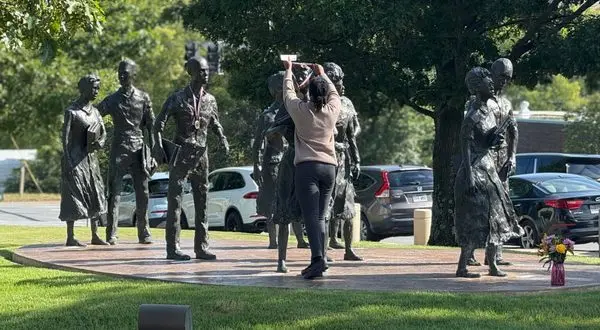
A Little Rock Central High School student hangs a medal around the neck of one of the bronze statues of the Little Rock Nine, part of a twentieth anniversary celebration of the memorial on Aug. 29, 2025. (Photo by Ainsley Platt/Arkansas Advocate)
Arkansas elected officials and high school students commemorated the twentieth anniversary of the Little Rock Nine monument on the state Capitol grounds Friday.
The memorial honors nine Black students who faced violence and hatred when they attempted to integrate Little Rock public schools in 1957.
Elizabeth Eckford, perhaps the most recognizable of the Little Rock Nine due to the famous photo of her being screamed at while trying to enter Little Rock Central High School alone, sat next to Gov. Sarah Huckabee Sanders at Friday’s commemoration of the memorial, which consists of life-sized bronze statues of the nine students walking toward the state Capitol.
Sanders, who attended Central High while her father was governor, lauded the Little Rock Nine for setting an example for others to follow. She credited their courage for enabling Central High to become “one of the most diverse” schools in Arkansas, “with students from every single walk of life.”
“It has now been nearly 70 years since the Little Rock Nine bravely integrated Central High School and brought about a wave of change to our country,” Sanders said. “Thanks to the statue standing behind us, they are forever memorialized in bronze, serving as a permanent reminder of our past so that we work together to ensure it doesn’t happen in our future.”
Eckford appeared to take issue with Sanders’ phrasing during her own remarks.
“We did not experience integration,” Eckford said with the bronze statue of her younger likeness at her back. “Integration did not happen. In fact, the school district continued to operate a dual school system until the 1970s. What we experienced was desegregation. The first year was tumultuous. We were pummeled daily and surrounded by hate speech.”
Eckford said the only way people could truly begin to understand one another was if “we honestly acknowledge our history.”
“My mantra has become that we can never have true racial reconciliation until we honestly acknowledge our painful, but shared, past. Not mythmaking, not pretty stories, but the real truth,” Eckford said.
The students became a central part of the Civil Rights era when Little Rock opted to begin desegregating its schools after the landmark Brown v. Board of Education decision. Former Arkansas Gov. Orval Faubus attempted to stop the Little Rock Nine from attending school using the Arkansas National Guard, but the students persisted, eventually earning a federal court victory that allowed them to attend classes.
The violence, however, did not stop. After mobs attempted to breach the school while the Little Rock Nine were attending classes, President Dwight Eisenhower federalized the National Guard and sent the 101st Airborne to tamp down on the violence and guard the students.
John Deering, a sculptor and a long-time political cartoonist who helped create the memorial, said the work represented the long walks the Little Rock Nine would have to take to attend their classes each day.
“The Nine will be here forever, facing the governor’s office, taking that long walk and proving that sometimes being terrified and being afraid isn’t the end of the journey, that’s really the beginning,” Deering said.
To view this story, or more news updates from Arkansas Advocate, click here.
WebReadyTM Powered by WireReady® NSI