












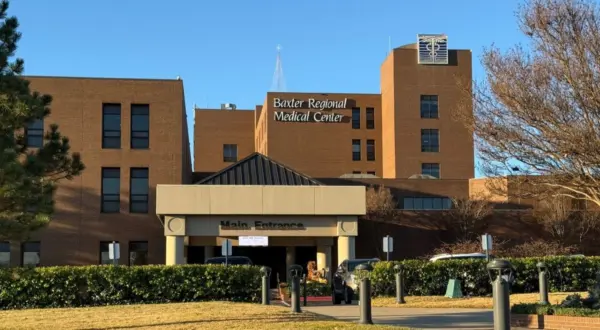
The move by Hospice of the Ozarks to separate itself from Baxter County Regional Hospital (BCRH) was being poorly planned and prepared for, leaving the hospital no choice but to step in and limit Hospice’s ability to move forward with a separation and rebranding plan.
The statement is included in an affidavit provided by Ron Peterson, CEO of BCRH, as part of an answer filed late Tuesday to a lawsuit brought by members of the Hospice of the Ozarks board seeking to have actions of the hospital declared null and void, including the appointment of 14 hospital board members and employees to the existing 11-member Hospice board giving Baxter Health a majority.
For more on the original filing by Hospice of the Ozarks visit the following story below at KTLO.com. It should be noted that in the original story, the hospital was referred to as Baxter Health. In this story, the hospital’s CEO refers to it as Baxter County Regional Hospital so KTLO is using that name.
Hospice board members file suit against Baxter Health over alleged bylaw violations
The actions taken by the hospital were necessary because the Hospice board had “gone rogue” and was “openly defiant, making clear that it intended to proceed with or without BCRH’s approval,” according to Peterson’s affidavit. He also claims that the hospital did not seek to remove anyone from the Hospice board when the issues of separation and rebranding became contentious in hopes that the two groups could “work together for the betterment of the community.”
Peterson wrote in his affidavit that unbeknownst to BCRH “Hospice had apparently been actively contemplating litigation against the hospital for months.”
In the summer and fall this year, it became “increasingly more difficult for BCRH to communicate with the Hospice board.” The Hospice board is alleged to have “declined several requests to meet with its counterpart at BCRH to discuss the situation,” according to Peterson’s affidavit.
Peterson lays out various services provided for Hospice by BCRH at low cost or no cost and writes that losing all of these support services would take hundreds of thousands of dollars from the Hospice budget each year — money which could be spent on patient care and other Hospice projects.
If Hospice separated from the hospital, Peterson said, it would have to bear the cost of IT services now provided by BCRH except for a few items such as software specific to the Hospice operation. He wrote that a bid obtained by Hospice for IT services came in at $7,500 for an “onboarding fee” and a recurring fee of almost $10,000 a month.
In addition, Peterson said the hospital’s food service department provides “pantry supplies” to Hospice at cost.
Laundry services are provided by the hospital to Hospice at no cost.
In his affidavit, Peterson writes that in the 39 years since Hospice of the Ozarks was founded, BCRH has “provided millions of dollars in support and subsidies” for the organization.
Peterson asserts that Hospice officials had been “unable to identify the additional costs it would incur as a result of its intent to rebrand and separate, “but in his affidavit, he put the figure at well in excess of $500,000 and noted that this would be in addition to the loss of subsidy and support BCRH provides to Hospice.
In Peterson’s affidavit, he asserts that, unknown to the hospital, the Hospice board had voted to rebrand to the name Care Connections of the Ozarks. He said this move was “based on the advice and work” of a Hospice board member.
Peterson denied that the hospital was attempting to gain control of Hospice funds. He said those bringing the lawsuit “have failed to identify a single financial transaction that has occurred that was not for the direct benefit of Hospice.”
He wrote that the hospital, “has not taken or used funds of Hospice, nor does it intend to.”
Peterson said the plaintiffs in the lawsuit “are the ones who sought and continue to seek to alter the status quo between BCRH and Hospice.
In legal arguments, the attorney representing the hospital says the Hospice board members as individuals do not have standing to bring the suit and that it is Hospice of the Ozarks that “is the real party of interest in this action.”
He also writes that there has been no showing of “immediate or irreparable harm” that would warrant the issuance of a temporary restraining order as the plaintiffs are requesting.
The plaintiffs in the suit are actually “challenging the business judgement of BCRH” which forced the hospital to take the steps it did.
The lawyer contends it is the plaintiffs who are “acting recklessly and causing harm to Hospice through the attempted separation and rebranding and by filing this lawsuit.”
Two Mountain Home-based judges, Andrew Bailey and Johnnie Copeland have recused from hearing the case.
DISCLAIMER
Mountain Lakes Broadcasting Corp.’s co-owner Heather Loftis is named as a defendant in the suit because she serves as a member of the Baxter Health Board of Directors.
WebReadyTM Powered by WireReady® NSI