












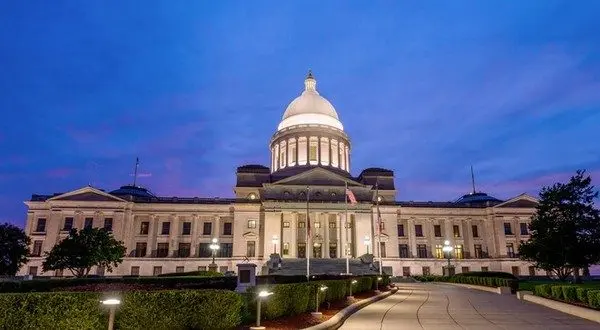
The $32 million Arkansas collected in taxes from the Powerball winner was among the one-time factors that led to finance officials’ decision to increase the state’s expected budget surplus to $334 million.
The announcement was welcome news for Arkansas lawmakers and Gov. Sarah Huckabee Sanders as they gear up for a legislative session in April that’ll focus primarily on the state’s budget.
But, as with any surplus, the additional money opens the door for just as many fights over how to spend it and what those decisions say about the state’s spending priorities.
Surpluses have been a boon for the state. A surplus of more than $1 billion the state accumulated 20 years ago helped Arkansas climb out of a decades-long school funding fight.
The Legislature then set aside nearly $500 million in surplus money to pay for public school facilities repairs that the state Supreme Court said were desperately needed to provide an adequate education.
And the surplus money is no longer divided up among lawmakers for individual projects in their legislative districts like museums or sidewalk repairs, a scheme that the state Supreme Court ruled clearly violated the Arkansas Constitution’s ban on strictly local legislation. Wide-ranging corruption probes over the subsequent use of surplus money seems to guarantee that similar workarounds won’t be revived either.
When the Legislature reconvenes in April, the question becomes how that money may be used for other longstanding needs. And it could also fuel an election-year push by Republicans to further cut taxes.
One of the biggest unknowns is how the future impact of the state’s voucher program factors into any surplus debate. The decision last month to send another $32 million toward the program which can be used for expenses such as private school tuition pushed the money spent on it this school year to nearly $310 million.
Another looming fight that could dominate the session and any talks about the surplus is the debate over the state’s 3,000-bed prison project in Franklin County advocated by Sanders. It’s unclear how much money will be sought to continue the prison’s construction, as well as whether any appropriation for it would be able to clear a three-fourths vote.
Both will become more apparent the morning after the March 3 primary, and not just because of election results. That’s when the Sanders administration is expected to present the Republican governor’s budget proposal for the coming fiscal year.
These debates and any further tax cut proposals would occur against the backdrop of decisions by President Donald Trump’s administration and Congress that continue to create uncertainty for Arkansas and other states.
That includes cuts to Medicaid, food stamps and other social safety net programs. The Trump administration’s shift in the federal government’s response to disasters could also put more of a burden on states like Arkansas.
The Arkansas Department of Finance and Administration noted that its decision to increase the surplus projection didn’t just rely on the one-time boost the state saw from items like the Powerball tax collections, calling the state’s economic conditions stable.
Sanders hasn’t said whether she plans to seek another tax cut when the Legislature convenes or during a special session later this year. Such a move will likely draw complaints from Democrats who have argued the state’s push for cutting income taxes has come at the expense of other state needs that are being underfunded.
But the headwinds the state faces in the coming year suggest lawmakers may want to be like any lottery winner and avoid spending their windfall too soon.
WebReadyTM Powered by WireReady® NSI