











𝙍𝙚𝙩𝙧𝙖𝙘𝙞𝙣𝙜 𝙊𝙪𝙧 𝙍𝙤𝙤𝙩𝙨.
𝗠𝘂𝗿𝗱𝗲𝗿, 𝗦𝗵𝗲 𝗪𝗿𝗼𝘁𝗲 𝗶𝗻 𝗕𝗮𝘅𝘁𝗲𝗿 𝗖𝗼𝘂𝗻𝘁𝘆 – 𝗣𝗮𝗿𝘁 𝟐
Welcome to another fascinating episode of 𝙍𝙚𝙩𝙧𝙖𝙘𝙞𝙣𝙜 𝙊𝙪𝙧 𝙍𝙤𝙤𝙩𝙨 with Sammy Raycraft and Vincent Anderson. Today, we have our special guest joining us the second time, Maryanne Edge.
Maryanne has chronicled the murders of Baxter County from the 1880s all the way up to 1999. Her two-volume book is called 𝙒𝙖𝙨 𝙞𝙩 𝙈𝙪𝙧𝙙𝙚𝙧? They are both available at the Baxter County Historical Museum, and they can be checked out at the Baxter County Library.
Caution: these stories are not for young children or the faint of heart.
The Assassination of Sheriff Edmonds
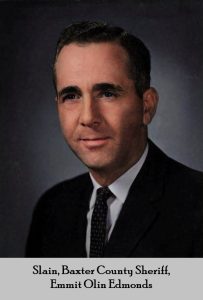
On the morning of May 4, 1968, Baxter County Sheriff, Emmett Olin Edmonds, aged 49, was shot to death in the county jail located on the third floor of the courthouse in Mountain Home, Arkansas. The incident occurred shortly after 8 a.m. when Edmonds and Deputy City Marshall Abe Heiskill, 65, went to the jail to feed breakfast to the six prisoners. Heiskill unlocked the door to the cell of Edwin Odus Pittman, a 28-year-old inmate held on a charge of attempting to burglarize the Fisk Chevrolet Company the previous month.
According to Heiskill, Pittman slammed against the cell door, striking Heiskill on the head and knocking him to the floor. Pittman then jumped on Edmonds, and as the two fell, Heiskill pulled his .357 Magnum pistol and struck Pittman one or two times, losing possession of the weapon in the process. Pittman grabbed the pistol, and as Edmonds started to rise, Pittman shot him.
A coroner's autopsy later revealed that Edmonds had been shot twice, in the chest and shoulder, with a small-caliber pistol, specifically a .25-caliber automatic found on the jail floor after the incident. Prosecuting Attorney Robert H. Dudley of Pocahontas declined to comment on how the small weapon entered the jail.
Pittman fled with Heiskill's fully loaded Magnum pistol. Deputy Sheriff James L. Wilson, 74, and Mrs. Pauline Edmonds were downstairs in the sheriff's office at the time. Wilson heard the shots, ran upstairs, met Pittman, and struggled with him. Wilson stated that Pittman stuck a gun against his chest and pulled the trigger, but it clicked without firing. Pittman threw Wilson aside and continued down the stairs, where he also encountered Mrs. Edmonds. City Policeman Dorlis Green saw Pittman descending to the first floor, pulled his "slapper," and then grabbed his pistol, but Pittman ran out of the courthouse.
State Trooper Larry Patterson, in the Cooper Drug Store across the street, was alerted by persons saying a man in the courthouse had a gun. Patterson chased Pittman down Sixth Street off the northeast corner of the square but lost him among the stores. Numerous residents reported sightings of Pittman or a man matching his description fleeing southward through town. Keith Halliburton, owner of the Discount Store on the east side of the square, heard shots and commotion, recognized Heiskill's voice calling for help, and saw a man exit the northeast basement door of the courthouse, crossing toward Sixth and Baker Streets. A state policeman soon followed. Halliburton noted the first volley of shots was not loud, but the second was. He saw Heiskill enter his store afterward, retrieve a .22 rifle and ammunition, and join the chase.
Bill Worthen, co-owner of the Dryer-Worthen Department Store, was walking on the east side of the square when he saw a man run from the courthouse, bloody on one side of his head, with a gun extended. Worthen ran to Cooper Drug Store and alerted Patterson, who pursued the man around the corner by Horton Jewelry store. Jim Horton, owner of Horton Jewelry, heard shots and yelling, then saw a man back out of the basement door, trot across the street while looking over his shoulder, blood running down the right side of his face, carrying a big gun. Horton locked his door as the man turned down Sixth Street, followed moments later by a patrolman.
Earle W. Johnson, owner of Johnson’s Super Market, confronted a bloody man near the Patio Restaurant, who had his right hand under his coat; the man proceeded toward the OK Tire Store.
Mrs. Nellie Mitchell, known as the newspaper lady and living at Main and Tenth Streets, saw a man in her backyard shortly after 8 a.m., his face a mask of blood. When asked what he was doing, he replied, "Oh, I’m just passing through." He walked across a vacant field, dropped to the ground, then edged along a hedge and crossed toward the school administration building, where Mitchell lost sight of him.
The suspect was last sighted crossing the low-water bridge on Dodd Creek near the junior high school, running down the creek's edge and crossing south of the bridge, as reported by a man digging for bait. Officers believed Pittman was attempting a jailbreak, as one bar in his cell was sawed out and another half-sawed, though no cutting tool was found.
Pittman, charged with first-degree murder that day, became the target of the most intensive manhunt in Baxter County's history, involving at least 200 regular law officers and volunteer deputies. The search focused south and west of Mountain Home, between the city and the White River.
Uneasiness spread; citizens armed themselves, and officers warned against admitting unidentified persons or leaving vehicle keys accessible. On Sunday, State Police appealed via radio for residents to check neighbors' homes.
The county was sectored off on a map in the sheriff's office, with patrols organized so no radio-equipped car was more than five minutes from another. Leads were checked using bloodhounds from the state penitentiary and a State Police airplane, but neither yielded any clues.
Round-the-clock roadblocks covered highways out of the county, with surveillance extending 100 miles. Missouri Pacific freight trains were inspected. A mobile communications center was set up on Church Street in Mountain Home, with over a dozen State Police units from up to 200 miles away. Officers from at least 10 counties volunteered, including Sheriffs Doyle Hickman of Boone County and George Hickey of Marion County, who played leading roles.
State Police were supervised by Capt. Boone Bartlett of Clarksville, and Col. Ralph D. Scott inspected the operation, praising coverage, efficiency, morale, and cooperation, noting officers' self-restraint in not shooting Pittman.
Numerous unverified sightings came in over the next days, including three in an hour on State Highway 178 west of Mountain Home around noon Saturday, at a Gassville cemetery, near Whiteville church on Highway 126 between Midway and Gassville, and other locations. Services at two Gassville churches were canceled Sunday. Officers searched through many barns and vacant buildings.
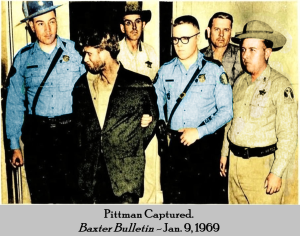
Pittman was captured about 12:45 a.m. on May 7 at the home of his wife's parents less than a block off Cotter's main business thoroughfare. He was spotted by volunteer deputy John Ed Isbell of Little Rock, watching from a nearby residence. Isbell notified Sheriff Hickman on his walkie-talkie that a man matching Pittman's description ran between the Maxwell home's rear door and a pickup truck.
Three police cars converged. Pittman was found hiding under the truck after searches of two cars and the cab. Hickman shouted for Pittman to come out with hands up and back toward him, but Pittman emerged facing him, raising arms to shoulder level before dropping one. Hickman, a six-time sharp-shooter award winner at Arkansas Peace Officers conventions, described it as the most dangerous situation he'd faced, fearing Pittman might reach for a gun. Pittman obeyed, and a .357 Magnum pistol, identified as Deputy Heiskill's, with one cartridge fired, was found at his feet. County Treasurer Don Cockrum spotted him under the truck, and Pittman crawled out feet first.
The house was dark, and his in-laws and Pittman's wife came to the door but stayed inside. About 20 officers and volunteers were present, including Deputy Sheriff Fred Brunson, County Judge James H. Baker, Deputy Prosecuting Attorney Terry M. Poynter, and others like Odus Hargrave, Bob Dust, Charles Thompson, Charles McMillan, Murel Partee, Ernest Partee, Lee Farrier, Frank Huckaba, Bob Russ Hurst, and State Trooper Don Lafarlette.
Pittman appeared dirty, scruffy beard, with matted hair, dressed in dark trousers, baggy coat, and open shirt. He had cigarettes, soap, toothpaste, and change in his pockets. After interrogation, he was taken to the Marion County jail at Yellville. Groups in the search for Pittman included State Police, FBI, city police, sheriff's deputies, Missouri state troopers, Game and Fish Commission employees, Arkansas and Missouri Forestry departments, and Arkansas State troopers. Even sheriffs and deputies from Greene to Carroll Counties and south to Van Buren County participated.
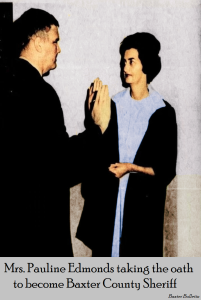
Three days later, on May 7, 1968, Governor Winthrop Rockefeller appointed Edmonds' widow, Pauline, to serve the remainder of his term. She had been a clerical deputy during his tenure and, as an appointee, was ineligible to succeed herself. She took the oath on May 8, 1968, from Municipal Judge Fred Engeler.
Sheriff Emmet Edmonds, serving from 1963 to 1968, was seeking a fourth Democratic term. He was a World War II Army veteran and former six-year State Police officer. Funeral services were held May 7 at First Baptist Church, officiated by Rev. Harold Elmore, with county officials and law officers as pallbearers.
Pittman was a native of Urbana, Illinois. He went to prison for armed robbery and assault in Indiana, and he was released from federal prison at Terre Haute, Indiana, in August 1967. He arrived in Baxter County in November 1967, and he married Marilyn Henninger of Cotter in January 1968.
Pittman was arraigned May 16, 1968, before Judge Harrell Simpson on first-degree murder, entering an innocent plea through attorney Ivan Williamson of Mountain View. Williamson filed for change of venue, contending Pittman couldn't receive a fair trial due to prejudice. Dudley requested postponement of the hearing due to prior commitments and need to investigate affiants. No hearing occurred that day; Pittman remained in Yellville jail. Dudley noted no immediate trial as Pittman hadn't been examined at Arkansas State Hospital for Nervous Diseases.
On May 23, Judge Simpson ordered Pittman committed to the state hospital for mental exam after Williamson indicated a likely insanity plea. The judge granted bill of particulars within seven days and postponed venue hearing. Pittman, in orange shirt, green slacks, loafers, said nothing. Brunson and Trooper John Kidwell transported him.
Circuit court convened June 11, 1968, but the murder case was not ready. Pittman returned June 13 from hospital with no comment on results.
On October 25, 1968, Judge Simpson granted venue to Sharp County, Ash Flat, trial tentatively December 17, 1968. Noted extensive media coverage, taped/broadcast witness statements, including a Baxter Bulletin article on Pittman’s past, massive hunt, and citizen warnings.
Pittman testified that he was denied visits without order, and his wife gave birth September 22, and Pittman had not visited the baby until court.
On December 13, 1968, a pre-trial was held at Ash Flat to consider motions. Simpson rescheduled to March 17, 1969, due to probable legislative jury selection change to random method following federal trend. At the hearing, Pittman had a haircut and shave by Sheriff Ray Martin, and cameras were banned.
The trial began March 17, 1969, at Ash Flat. Pittman changed plea to guilty; jury (10 men, 2 women) qualified, not for death penalty; state recommended life. Mrs. Edmonds said she preferred life over death, and she understood the circumstances as former deputy/sheriff.
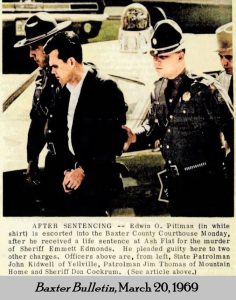
Pittman was sentenced to life. Pittman looked clearly shaken as his hands were trembling and often holding his head in hands. He was transferred to the state penitentiary immediately.
According to the Arkansas Department of Correction, Pittman was booked into prison on March 17, 1969, and died there on November 6, 2004.
Sheriff Emmet Olin Edmonds was born September 16, 1918, in Hammond, Ozark County, Missouri, to Olin E. and Docia “Baker” Edmonds. He spent most of his childhood till he was 11 years old in Nottinghill, Ozark County, Missouri. He was the Baxter County Sheriff and assassinated on May 4, 1968, on the stairwell of the Baxter County Courthouse. He was laid to rest in the Baxter Memorial Gardens. Edmonds was the first sheriff killed in duty since Abraham G. Byler in 1892. Sherrif Eugene Mooney died accidentally in the early 1900s.
𝐓𝐡𝐚𝐧𝐤𝐬, 𝐑𝐚𝐩𝐩’𝐬!
A special thank you to Rapp’s Barren Brewing Company for their sponsorship of 𝙍𝙚𝙩𝙧𝙖𝙘𝙞𝙣𝙜 𝙊𝙪𝙧 𝙍𝙤𝙤𝙩𝙨. Their continued partnership helps us share the real stories of the Ozarks, the kind you don’t always find in textbooks, but hear heart-to-heart across backroads and kitchen tables.
It’s thanks to local supporters like Rapp’s that the voices of our past still echo through these hills.
The next time you’re in downtown Mountain Home, stop by Rapp’s and thank Russell Tucker and the whole crew. Rapp’s Barren Brewing Company is helping us pour heart back into our local history.
Sip. Savor. Sojourn.
𝙍𝙚𝙩𝙧𝙖𝙘𝙞𝙣𝙜 𝙊𝙪𝙧 𝙍𝙤𝙤𝙩𝙨