


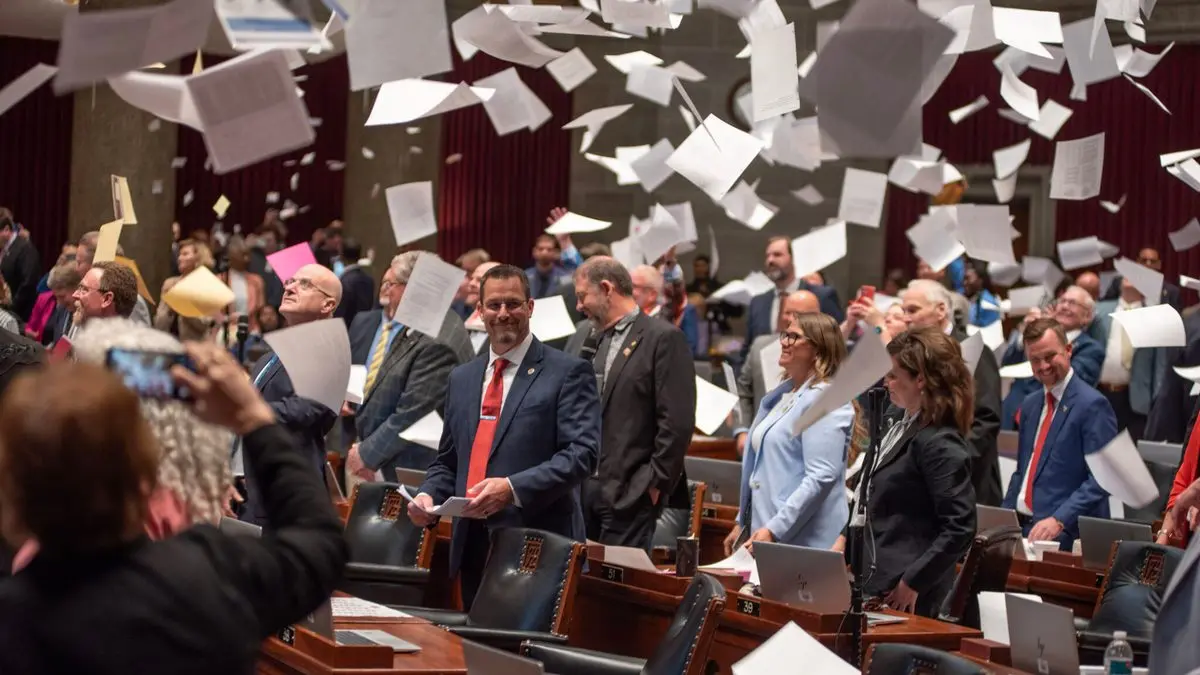
State Rep. Brandon Phelps, a Republican from Warrensburg, smiles as the Missouri House tosses bills into the air at the adjournment of session Friday (Annelise Hanshaw/Missouri Independent)
By: Jason Hancock/ Missouri Independent
The Missouri General Assembly adjourned Friday without the factional warfare and late-session meltdowns that have come to define the Capitol in recent years, ending a 2026 session marked less by dysfunction than by a return to legislative basics.
Republicans used their supermajorities to advance major pieces of Gov. Mike Kehoe’s agenda, including a proposed constitutional amendment aimed at expanding the sales tax to replace the income tax, a ban on intoxicating hemp products, a wide-ranging public safety package and new abortion legislation. Lawmakers also approved a $50.7 billion state budget and a health care bill expanding maternal care, contraception access and telehealth.
But the session’s defining feature may have been that the legislature mostly functioned.
“I think we can agree that this session was productive and resulted in monumental wins for many Missourians,” Kehoe told reporters Thursday. “While we may not always agree on every issue, I believe Missourians are best served when leaders show up, work hard and stay focused on results. This year, the General Assembly did exactly that.”
Even Democrats who opposed much of the Republican agenda acknowledged the legislature and especially the Senate operated more smoothly than it has in recent years.
“There’s a duality to it,” said state Sen. Stephen Webber, a Columbia Democrat. “I think we collaborated pretty well. I think it was more bipartisan than most people could probably imagine. But I’m also frustrated that there’s a lot of important things that could have been passed that weren’t.”
House Minority Leader Ashley Aune, a Kansas City Democrat, also pointed to bipartisan successes, including bills targeting sex trafficking, expanding benefits for veterans and allowing pregnant women to finalize divorces.
“I think it was fair to say that we had some good bipartisan successes this year,” Aune said.
But she said those successes were overshadowed by Republicans’ failure to pass broad affordability measures, especially property tax relief.
“This session has got to be considered a failure because of majority Republicans’ refusal to do anything to make life more affordable for Missouri families,” Aune said.
The relative calm marked a sharp departure from the tone surrounding recent sessions.
In 2023, the Missouri Senate collapsed into gridlock on the final day, derailing priorities amid Republican infighting. In 2024, a 41-hour filibuster by the Senate’s Freedom Caucus helped define another turbulent year. In 2025, Senate Republicans used a rarely invoked procedural move to cut off Democratic filibusters and pass measures rolling back voter-approved abortion rights and paid sick leave protections.
The 2026 session began with similar expectations of conflict. Instead, lawmakers got through the budget on time and gave Kehoe victories on taxes, public safety, abortion and hemp regulation. In fact, the legislature passed more policy bills this session than the last two combined.
But the final days were not without some drama.
Republican state Sens. Mike Moon of Ash Grove and Joe Nicola of Grain Valley used the filibuster to occasionally slow the chamber Thursday and Friday, upset at bills they believe violate a constitutional prohibition on including multiple subjects.
Moon was also frustrated that his proposal to enshrine fetal personhood in the Missouri Constitution never gained traction in the GOP-dominated Senate.
“I’m looking at it primarily from the moral aspect,” Moon said. “If we truly value lives, we should want to protect each and every one of them.”
Across the rotunda in the House, a wide-ranging education bill was scuttled in a committee Friday after its chairman, Republican state Rep. Jim Murphy of St. Louis County, was asked to kill it by the archbishop of St. Louis.
The reason for the archbishop’s opposition was a bipartisan provision in the bill stripping oversight of the state’s voucher program from State Treasurer Vivek Malek.
What passed
The centerpiece of the GOP agenda was a plan to ask voters to give lawmakers new authority to expand sales and use taxes in order to phase out the income tax. The proposal was the top priority for Kehoe and Republican leaders, who argued Missouri needs to join states that have moved away from taxing income.
“Missouri has an opportunity to join a growing number of states that have eliminated the state income tax,” said Senate Majority Leader Tony Luetkemeyer, a Parkville Republican.
Kehoe called the proposal “a transformational moment for our state.”
“It’s about more than just taxes,” he said. “It’s about growth. It’s really about competitiveness, and it’s about sending a message across the country that Missouri will compete and Missouri will win.”
Democrats argued the plan would shift costs onto working families, seniors and low-income Missourians by relying more heavily on consumption taxes. A lawsuit filed in Cole County after lawmakers approved the proposal argues it should be knocked off the ballot or have its summary rewritten because it bundles too many subjects together and uses misleading language.
The only legislation lawmakers must pass each year is the state budget. This year, that job came with tighter margins than lawmakers have grown accustomed to after several years of large surpluses.
Lawmakers approved a $50.7 billion spending plan for the fiscal year beginning July 1, trimming roughly $300 million from Kehoe’s general revenue proposal while using about $2.3 billion from accumulated surpluses. That leaves approximately $500 million available to help balance the budget when a new General Assembly convenes next year.
“This is a fiscally responsible budget for fiscal year 2027,” said House Budget Committee Chairman Dirk Deaton, a Seneca Republican who cannot return next year because of term limits. “Fiscal years 2028, 2029 as you go forward, those are going to have to be looked at individually, and they might have to make different decisions.”
Luetkemeyer pointed to the budget as evidence lawmakers were able to make hard choices despite diminished flexibility.
“Despite a tighter budget than last year, we still restored $79 million in disability services, $15 million in pregnancy resource centers and prohibited DEI funding in higher education,” he said.
Public safety was another area where Republicans claimed major victories.
Kehoe signed legislation he said would help “stop the revolving door of violent offenders,” strengthen sentence transparency and give the criminal justice system “the tools needed to keep dangerous individuals off of our community streets.”
Luetkemeyer said the public safety bill was focused on “protecting children, holding violent criminals accountable and reducing an early release for dangerous offenders.”
The package included a ban on nonconsensual distribution of intimate digital depictions, provisions allowing lifetime protection orders for victims of some felonies, a prohibition on cyberstalking and procedures for involuntary outpatient treatment of people with severe mental illness. Earlier in the session, Kehoe signed legislation aimed at cracking down on sex trafficking and helping law enforcement and first responders identify and prevent the crime.
Republicans also passed the “Born-Alive Abortion Survivors Protection Act,” their signature abortion bill of the year. The legislation requires medical care for babies born alive after attempted abortions and creates criminal penalties for violations. Kehoe called it “another testament to Missouri’s pro-life values.”
Other measures drew broader support, including legislation clarifying that pregnancy cannot prevent a divorce from being finalized. Kehoe signed that bill in April, saying he was proud to ensure “pregnancy is never a barrier to prevent a woman from seeking a divorce in unsafe situations.”
The legislature also sent Kehoe a health care bill expanding women’s and maternal health coverage, increasing access to telehealth, allowing women with private insurance to obtain a yearlong supply of contraceptives and requiring licensed child care facilities to maintain allergy treatment policies.
Lawmakers also banned intoxicating hemp products, including THC seltzers and hemp-derived edibles that have proliferated in gas stations, liquor stores and smoke shops. The ban takes effect Nov. 12 and aligns state law with federal restrictions.
What failed
Property tax relief was one of the legislature’s clearest failures.
After both chambers spent the interim studying the issue, the House and Senate each passed bills requiring separate tax rates for different classes of property residential, commercial, agricultural, personal and infrastructure to avoid burden-shifting when one type of property rose in value faster than others.
But the chambers could not reconcile their differences. A final push to salvage pieces of the plan, including provisions allowing the minimum school levy to be reduced, failed near the end of session.
For Aune, the collapse of property tax legislation was one of the clearest examples of a session that functioned better than in recent years but failed to address what Democrats considered the most urgent issue facing families.
“On the first day of session, House Democrats said that the absolute top priority for this year must be providing much-needed relief to families struggling to keep up with the ever-rising prices of everything,” Aune said. “But Democrats don’t set the agenda.”
Aune said few constituents were asking lawmakers to eliminate the income tax or raise sales taxes. What they wanted, she said, was property tax relief.
“Republicans have supermajorities in both chambers,” Aune said. “If something doesn’t pass, it’s because they don’t want that to pass.”
Webber criticized House Republicans for blocking legislation that would have expanded arbitration rights for first responders, arguing lawmakers missed a chance to help police, firefighters and other emergency personnel negotiate over pay, benefits and workplace safety.
Efforts to restore Missouri’s presidential primary also collapsed. Missouri last held a presidential primary in 2020, and attempts this year to revive it were stripped out of a larger elections bill. A stand-alone version passed the House and cleared a Senate committee, but never reached the Senate floor.
Video lottery terminals met a similar fate. A proposal to legalize the machines and create a new revenue stream for the state died in a Senate committee with roughly two weeks left in session. The defeat came as Attorney General Catherine Hanaway has stepped up enforcement against unregulated machines already operating in gas stations and other retail locations.
Other priorities that failed included Medicaid work requirements, new artificial intelligence regulations and a proposal to grade public schools on an A-to-F scale.
For Kehoe, the session was evidence that the Capitol can still deliver.
“The session was about making Missouri safer, stronger and more competitive and more accountable to the people we serve,” he said. “It was about keeping our promises and laying a foundation for growth.”
The Independent’s Rudi Keller contributed to this story.
For more state news from Missouri visit missouriindependent.com.
WebReadyTM Powered by WireReady® NSI