


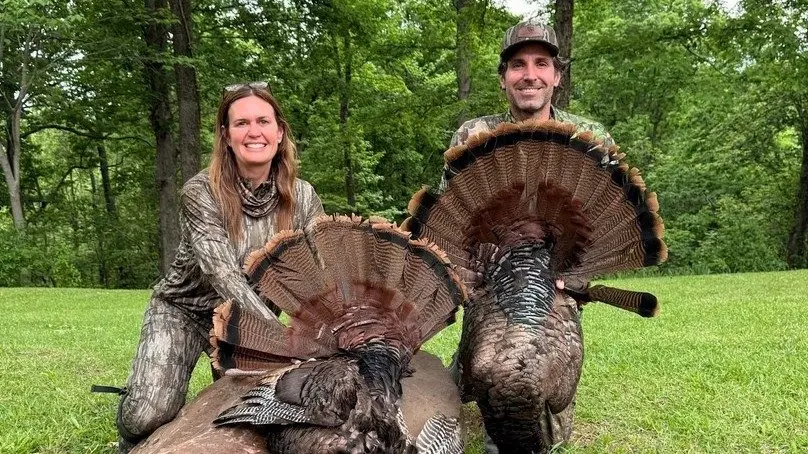
Gov. Sarah Huckabee Sanders and Arkansas’s first gentleman, Bryan Sanders, both harvested mature gobblers in southern Arkansas in the first week of the season.
Turkey season wrapped in Arkansas Sunday night with highest harvest in 20 years according to the AGFC.
Arkansas turkey hunters checked 13,591 turkeys during this year’s official turkey hunting season according to historical data, this is the highest spring turkey harvest since 2006.
“Arkansas had a good amount of mature gobblers on the ground this year, thanks to conservative seasons during the last few years promoting high gobbler carryover. This was complemented by good weather two years ago that enabled the birds to take advantage of improved habitat in many pockets across the state,” Allison Fowler, assistant chief of wildlife management for the Arkansas Game and Fish Commission, said. “We also saw a change in our season structure this year that offered split opening weekends, and we’re analyzing those results to see if it played a large role in the harvest.”
Although this is the highest harvest since 2006, Arkansas’s record turkey harvest was in 2003, when hunters checked 19,947 birds. A quick dive into the comparison reveals that this year’s harvest isn’t too far off that mark when accounting for a few major differences in season structure.
In 2003, hunters shot 4,610 jake turkeys. Nearly a quarter of the harvest was made up of these immature male birds. Only 15,225 mature gobblers were taken that spring.
The remaining 112 turkeys counted in the 2003 harvest were bearded hens, which were also legal to harvest at that time. The legal harvest of bearded hen turkeys was eliminated in 2021 to maximize reproductive success in Arkansas’s flock.
AGFC biologists are cautiously optimistic that Arkansas’s turkey population is still in good shape following the season.
“Our poult surveys last year indicated less reproductive success than in 2024, and we know harvest rates are tightly linked to the reproduction two years prior,” Fowler said. “Just like this year benefited from higher than average reproduction in 2024, next season may see a decline because of moderate reproduction in 2025. We still have a lot of jakes on the landscape that will be adults next year, and we should see a decent complement of this year’s adult gobblers surviving. Still, a slight decline next season won’t be shocking; you really never know until the season is here.”
WebReadyTM Powered by WireReady® NSI