


By: Tess Vrbin/ The Arkansas Advocate
Fayetteville resident Jen Cole tries her best to use her monthly $20 in nutrition assistance on what she needs most, but it still doesn’t go very far.
“This month, I was like, Okay, I need olive oil for healthy cooking, and I need smoked paprika, and that’s going to take up most of my food stamps,'” Cole said. “So I got that and a couple of avocados and an onion, and that was it.”
Cole gets more for her money at a local farmers market than at a grocery store, and she also uses Meals on Wheels and the food pantry where she volunteers. She said the pantry has seen a surge of families seeking assistance in recent months.
Demand for help putting food on the table in the nation’s most food-insecure state has increased while grocery prices have also increased, and federal restrictions and cuts to nutrition aid are months from taking effect.
The federal tax and spending cuts measure known as the One Big Beautiful Bill Act of 2025 requires states to share some of the administrative cost of the Supplemental Nutrition Assistance Program for the first time in the food assistance program’s 87-year history. For Arkansas, that will eventually amount to $24 million more a year.
The additional cost and a $6.7 billion state budget lawmakers approved that didn’t address that need has sparked concerns about how the state will cover the funding gap in a state where roughly one in 10 households are on SNAP.
More than 220,000 Arkansans in about 118,000 households receive SNAP benefits as of April 26, Department of Human Services spokesperson Gavin Lesnick said. Both figures have dropped since January, according to U.S. Department of Agriculture data.
Under the budget Republican Gov. Sarah Huckabee Sanders signed last month, DHS’ $1.86 billion budget will remain mostly flat compared to the current fiscal year.
When asked how the agency will absorb higher administrative costs, Lesnick said officials are “continuing discussions on this funding and also exploring efficiencies within the Division of County Operations,” which administers SNAP.
The lack of clarity from the state about its plan to absorb the cost is concerning, especially with little to no change to the agency budget, said Sylvia Blain, CEO of the Arkansas Hunger Relief Alliance.
, and so I believe it needs to be a line item to make sure that it’s covered,” she said.
Republican Sen. Jonathan Dismang of Searcy, co-chairman of the Joint Budget Committee, said he has been “assured repeatedly by the administration and by DHS that this is something they can absorb inside their budget.”
In 2023 and 2025, Dismang sponsored legislation to raise SNAP’s asset limit in order to help Arkansans build enough wealth to no longer need food assistance. Neither bill passed after other Republicans said the policy promoted government dependency.
The current state budget set aside $100 million for DHS that has sat untouched, and the same amount will be set aside in the next fiscal year that begins July 1, Dismang and Lesnick both said.
Blain and other advocates for nutrition assistance have expressed concern about how the state can handle additional costs when it’s collecting less revenue as a result of phasing out the income tax. The Legislature approved the state’s fourth tax cut since 2023 in a special session last week.
Democrats and community advocates told Republican lawmakers that the SNAP funding shortfall was one reason not to cut taxes, especially when the lower and middle classes see little savings.
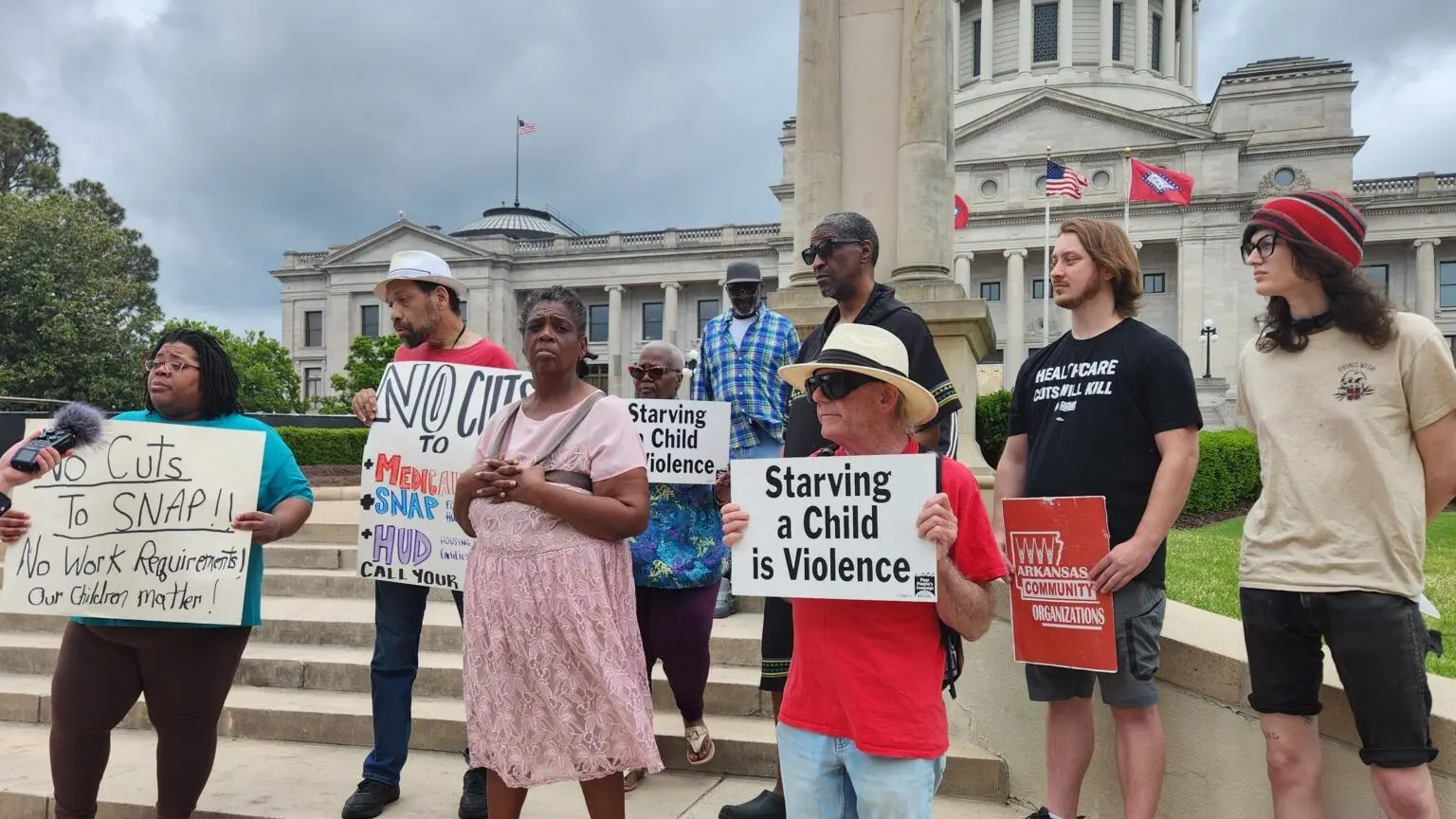
Valencia White, who was among activists with Arkansas Community Organizations rallying outside the Capitol against the cuts on April 23, said she used to forgo eating so her children would have enough food.
“When they were younger, I would cry because my money didn’t go as far as it should have, and I had to feed my children,” White told reporters.
The One Big Beautiful Bill Act incentivizes states to keep their rates of overpaying or underpaying SNAP benefits below 6% in order for the federal government to continue to pay 100% of the cost of assistance.
States with error rates above 6% will pay at least 5% of SNAP benefit costs starting Oct. 1, 2027.
Arkansas’ error rate has consistently been above that threshold. It was 7.43% as of April 13, an increase from December. Lesnick said DHS “will continue to look for new ways” to reduce the error rate below 6%.
Those efforts include monthly staff training, creating a quality assurance team, enhancing fraud detection capacity with the help of a USDA grant “and investing in AI tools within the eligibility system to reduce human data errors and reduce repetitive tasks, freeing up caseworker resources to detect errors,” Lesnick said.
After Sanders signed the tax cuts into law Wednesday, House Speaker Brian Evans said the Legislature is keeping a close eye on changes to SNAP costs.
,” the Cabot Republican said.
Arkansas already had work requirements for SNAP recipients before the latest mandates. As of November, adult SNAP recipients younger than 64 and without dependents younger than 14 must work if they are capable of working. Research shows that SNAP work requirements reduce food assistance enrollment instead of boosting employment rates.
Additionally, Arkansas is one of several states that will ban the use of SNAP funds to purchase soda, candy, juices with less than 50% natural juice and other highly processed foods as of July 1. Sanders said last year that taxpayers should not be “subsidizing poor health.”
This upcoming change prompted concerns from Dismang that local retailers in rural areas could stop serving SNAP recipients if the state doesn’t provide clear guidance on how to implement the new rules.
On Wednesday, the Joint Budget Committee reviewed a $1.2 million contract with Sifter Solutions, a Chicago-based consultant that provides regularly updated lists of restricted products to retailers in states with SNAP junk food bans.
People facing food insecurity usually don’t seek out unhealthy foods with their limited benefits, Cole and Wannalitha Anderson both said. They volunteer at the food pantry at Fayetteville’s St. James Baptist Church, which increased distribution from once to twice a week last year to meet demand.
not going to fix anything,” Anderson said.
The charitable food network has been more difficult to sustain since the federal government ended several grants in 2025, including one that funded Anderson’s job at AmeriCorps focused on addressing food insecurity.
The effects of the war in Iran, tariffs and other decisions from Washington D.C. caused the pantry to run low on food on April 30, which Anderson said is unusual.
“Sometimes it’s feast and sometimes it’s famine,” Anderson said.
For more news around the state of Arkansas visit The Arkansas Advocate.
WebReadyTM Powered by WireReady® NSI